Log in as user "Abnahme"
(commissioning) (user level [2]) in KranOS. See Connecting laptop or
tablet computer with ABUControl.
Log in as user "Abnahme"
(commissioning) (user level [2]) in KranOS. See Connecting laptop or
tablet computer with ABUControl.The hoist profile can be adjusted to individual usage in the acceleration and braking time as well in the maximum and minimum speed.
For this work step, access from a laptop or tablet computer to KranOS is necessary. The user "Abnahme" (commissioning) (user level ‚[2]) must be logged in.
|
Overview: Navigation in KranOS |
|
User "Abnahme" (commissioning) à "Hoist" à "Hoist profile parameter" |
Log in as user "Abnahme"
(commissioning) (user level [2]) in KranOS. See Connecting laptop or
tablet computer with ABUControl.
Select the desired hoist (e.g.
Hoist 1) in the main menu.
● The window for the requested hoist appears.
Click on "Hoist profile
parameter" in the "Settings" menu (three horizontal bars).
● The "Parameter" window for the corresponding crane axis appears.
● The current values are displayed.
Set the desired values.
|
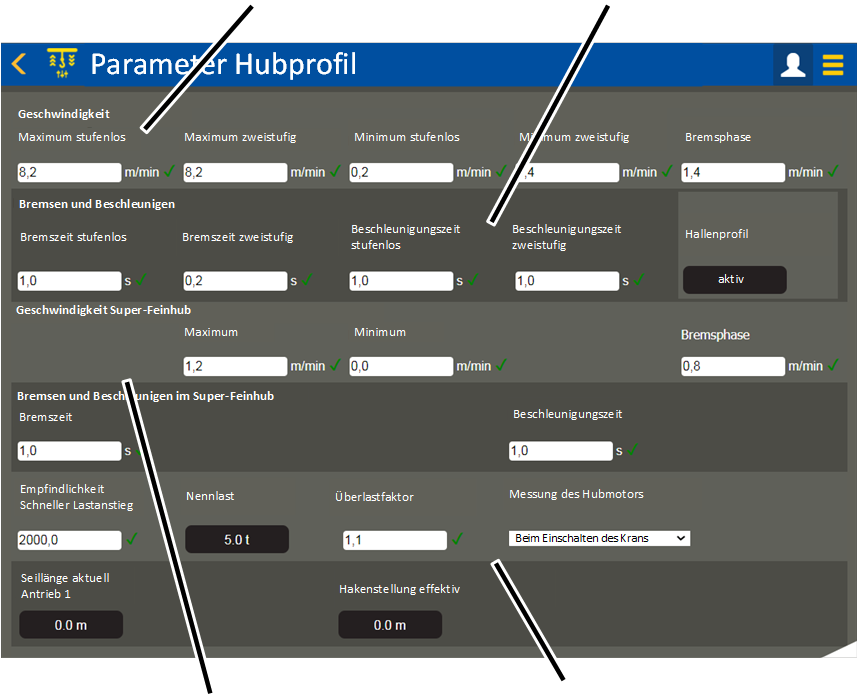
"Speed" section |
"Braking and accelerating" section |
|
| |
|
"Speed super precision lifting" and "Braking and accelerating in super precision lifting" sections |
Additional sections |
"Speed" section:
This section pertains to the maximum and minimum lifting speed of the hoist in connection with the various movement profiles.
The hoist lifts/lowers slower at a low value and faster at a high value.
The movement profiles can be selected on the "Movement profile" page. See Selecting movement profiles (travel profiles and hoist profiles) [1] [2]‚.
─ "Maximum step-less": The maximum lifting speed with a step-less movement profile.
If the button is pressed and held in the second level, the hoist accelerates maximally to this lifting speed.
With double lifting speed (optional): If the hoist can lift and lower with double lifting speed, the value in this input field also applies for the maximum possible additional lifting speed (above 100% of the lifting speed according to the type plate). The lifting speed is specified on the type plate of the hoist motor and in the technical data, and can therefore be increased up to double. The actual maximum possible additional lifting speed (over 100%) depends on the attached load and is automatically reduced according to the attached load.
─ "Maximum two-step": The maximum lifting speed with a two-step movement profile.
If the button is pressed and held in the second level, the hoist accelerates to this lifting speed.
With double lifting speed (optional): If the hoist can lift and lower with double lifting speed, the value in this input field also applies for the maximum possible additional lifting speed (above 100% of the lifting speed according to the type plate). The lifting speed is specified on the type plate of the hoist motor and in the technical data, and can therefore be increased up to double. The actual maximum possible additional lifting speed (over 100%) depends on the attached load and is automatically reduced according to the attached load.
─ "Minimum step-less": The slowest lifting speed with a step-less movement profile.
If the button is pressed and held in the first level, the hoist accelerates to this lifting speed.
─ "Minimum two-step": The slowest lifting speed with a two-step movement profile.
If the button is pressed and held in the first level, the hoist accelerates to this lifting speed.
─ "Brake phase": Lifting speed at which the hoist brakes in the brake phase immediately before the hoist limit switch is activated.
"Braking and accelerating" section:
This section pertains to the braking time and the acceleration time of the hoist in connection with the various movement profiles.
The hoist drive brakes or accelerates faster at a low value and slower at a high value.
The movement profiles can be selected on the "Movement profile" page. See Selecting movement profiles (travel profiles and hoist profiles) [1] [2]‚.
─ "Braking time - step-less": Time in which the hoist drive brakes with a step-less movement profile.
The entered time always refers to the complete braking from the maximum lifting speed according to the type plate until a standstill is reached.
With this value, the hoist continues braking when the key is released from the first or second level until the key is then switched back in the first level.
─ "Braking time - two-step": Time in which the hoist drive brakes with a two-step movement profile.
The entered time always refers to the complete braking from the maximum lifting speed according to the type plate until a standstill is reached.
With this value, the hoist brakes when the key is released from the first or second level.
With double lifting speed (optional): The value specified refers to the lifting speed according to the type plate. With double lifting speed, the braking time is also doubled in real crane operation depending on the load.
Entering a very small value enables a very spontaneous braking behaviour which, even for hoists with frequency converters, approaches the braking behaviour of hoists with contactor control.
─ "Acceleration time - step-less": Time in which the hoist drive accelerates with a step-less movement profile.
The entered time always refers to the complete acceleration from a standstill until the maximum lifting speed according to the type plate is reached.
With this value, the hoist accelerates from a standstill when the key is pressed in the first level, or if the key is pressed and held in the second level.
With double lifting speed (optional): The value specified refers to the lifting speed according to the type plate. With double lifting speed, the acceleration time is also doubled in real crane operation depending on the load.
─ "Acceleration time - two-step": Time in which the hoist drive accelerates with a two-step movement profile.
The entered time always refers to the complete acceleration from a standstill until the maximum lifting speed according to the type plate is reached.
With this value, the hoist accelerates from a standstill when the key is pressed in the first level, or if the key is pressed and held in the second level.
With double lifting speed (optional): The value specified refers to the lifting speed according to the type plate. With double lifting speed, the braking time is also doubled in real crane operation depending on the load.
Entering a very small value enables a very spontaneous braking behaviour which, even for hoists with frequency converters, approaches the braking behaviour of hoists with contactor control.
"Building profile" section:
─ "Building profile": This displays whether a building profile is available for the crane.
"Speed super precision lifting" and "Braking and accelerating in super precision lifting" sections:
These sections refer to the maximum and minimum lifting speed of the hoist as well as the braking time and acceleration time in connection with the super-precision lifting function.
With the super-precision lifting option, the hoist can be switched to an especially slow lifting speed. This enables extremely exact positioning of the load.
With activated super-precision lifting in pole-switchable hoist drives, the frequency converter is switched from winding with fast lifting speed to winding with slow lifting speed.
For single-winding hoist drives that are not pole-switchable, (e.g. GM7000.2), the speed of the hoist motor is monitored by the frequency converter using a separate absolute rotary encoder, thus also enabling full torque at very slow lifting speeds so that the load can be held until a standstill is reached even without braking.
The settings in this section refer to the technology actually used on the crane, including super-precision lifting for pole-switchable hoist drives as well as on hoist drives that are not pole-switchable.
Super-precision lifting can be switched on and off at the transmitter or the pendant control.
The values entered in these sections (braking time, maximum speed, minimum speed, acceleration time, brake phase speed) apply when super-precision lifting is switched on on the transmitter or on the pendant control.
The meaning of the values is identical for the sections "Speed" and "Braking and accelerating".
Additional sections:
─ "Sensitivity rapid load increase": Sensitivity with which the lifting of a load with a sudden jolt is registered. The displayed number is a threshold value that is dependent on time and measured load. The smaller the number, the more sensitively ABUControl reacts to a rapid load increase. The measuring of the rapid load increase always occurs 50 ms after pressing the lift button. If a rapid load increase is registered, the hoist brakes to slow lifting speed, maintains the slow lifting speed for 2 seconds and then accelerates again if the key continues to be held pressed at the second level.
─ "Load capacity": Maximum load capacity of the hoist.
─ "Overload factor" Factor (multiple) of the maximum load capacity at which the overload protection is activated.
─ "Measurement of hoist motor": Here you set whether or not the hoist motor will be electrically measured upon switching on the crane. During measuring, certain electrical values of the hoist motor are checked with a test current, compared with the measurement results from the initial start-up of the crane at the commissioning, and the frequency converter is set accordingly. In this way, the frequency converter can take into account the thermal state of the hoist motor during running operation. Normally, measurement upon switching on the crane is activated. With older frequency converters (ATV32), the measurement may need to be deactivated.
─ "Current wire length Drive 1": Length of the entire wire rope that currently has been unrolled from the cable drum to the fixed point.
With twin hoist: The "Current wire length drive 2" is also displayed. The displayed value is then the respective length of wire rope that currently has been unrolled from the cable drum up to the compensating sheave (middle deflection roller above on the wire rope hoist or on the bottom block).
─ "Hook position effective": Hook position (measure distance from centre of cable drum to centre of deflection roller of bottom block) based on the wire length. The reeving and also both cable drums on twin hoists are taken into consideration here.
The sections "Speed", "Braking and accelerating", "Speed super precision lifting", "Braking and accelerating in super precision lifting" as well as the selection field "Measurement of hoist motor" are displayed in KranOS, however, the entered values are not evaluated.
For a hoist with contactor control, the slow and fast winding of the hoist motor is switched via contactors. Speed, braking time and acceleration time are determined by the physical properties of the hoist motor and not regulated by the frequency converter.